

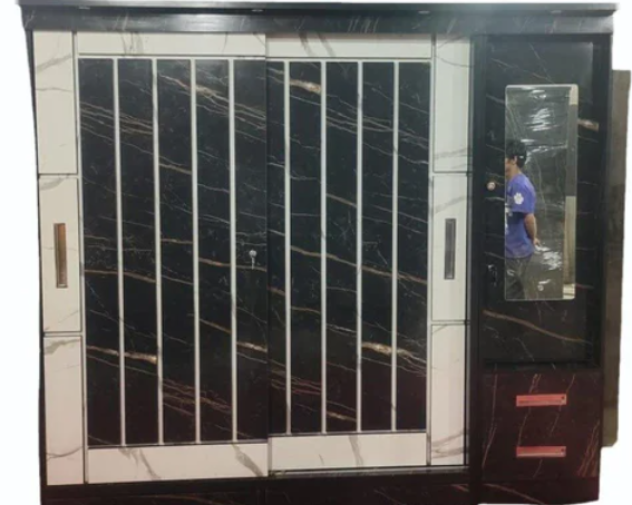
A Modular Particle Wood Sliding Wardrobe is often considered when a bedroom needs substantial storage but has limited space in front of the wardrobe. Unlike conventional hinged doors that swing outward, sliding panels move horizontally along the wardrobe frontage.
That space-saving characteristic can be useful in compact Nagpur apartments, but buyers should examine the complete system before assuming every sliding wardrobe will suit a small room.
Sliding Doors Solve a Specific Space Problem
The primary advantage of a sliding wardrobe is door clearance.
With a hinged wardrobe, furniture or walking space must remain clear in front of each door. A sliding wardrobe removes most of that swing requirement.
This can be useful when the wardrobe faces:
- The side of a bed
- A narrow passage
- A dressing area
- Other bedroom furniture
- A compact circulation zone
However, remember that sliding doors overlap, meaning the entire wardrobe interior is generally not exposed simultaneously.
Modular Design Adds Planning Flexibility
Modular wardrobes can be configured around different storage needs, depending on the available product options.
Before choosing the internal layout, divide your belongings into categories.
For example, estimate how much space you need for hanging clothes compared with folded clothes. Then consider drawers, accessories, bedding, bags, and occasional-use items.
A practical interior might combine hanging rods, shelves, drawers, and upper compartments rather than repeating identical shelves throughout.
Compare the Sliding Mechanism Carefully
The sliding system is one of the most frequently operated components.
Doors should move predictably along their tracks without excessive effort. Buyers should understand the roller or sliding hardware used and any recommended maintenance.
Tracks also need routine cleaning because accumulated dust and debris can affect moving components.
This is relevant in Nagpur households where dust exposure can vary considerably between neighbourhoods and building environments.
Evaluate the Particle Wood Construction
Engineered wood makes modular furniture available in numerous finishes and configurations.
When comparing wardrobes, ask about panel specifications, edge finishing, backing, shelves, and hardware.
Do not evaluate particle wood furniture purely by thickness or weight. Overall construction, proper assembly, fitting quality, and appropriate usage all contribute to the finished wardrobe.
Protection from persistent moisture is also important.
Sliding Versus Hinged Wardrobes
Neither design is universally superior.
Sliding wardrobes are particularly useful where front clearance is restricted and a streamlined appearance is preferred.
Hinged wardrobes, meanwhile, can provide direct access to individual compartments and allow multiple doors to be opened at once.
Your bedroom layout should guide the choice.
If there is generous space in front of the wardrobe, hinged doors remain a practical option. If the bed sits relatively close to the storage wall, sliding doors may use the available space more efficiently.
Avoid Ignoring Installation Access
Large wardrobe panels must reach the intended room before installation.
In apartments, consider staircase, lift, corridor, and entrance dimensions. Modular construction can simplify movement compared with some fully assembled furniture, but installation requirements should still be discussed before ordering.
Also check the floor and wall conditions in the installation area.
Make the Decision Around Everyday Use
KSN FURNITURE works with furniture buyers in Nagpur, including homeowners considering wardrobes for different bedroom layouts. When comparing a Modular Particle Wood Sliding Wardrobe, buyers should review dimensions, storage configuration, material specifications, sliding hardware, and installation requirements together.
A sliding wardrobe earns its place in a compact room when it improves movement without sacrificing useful storage.
The objective should not simply be to fit the largest possible wardrobe against the wall. A better approach is to preserve comfortable circulation while creating organised storage that reflects how clothing and personal items are actually used.